
In this article · 7 sections
- Who regulates food safety in Long Beach
- Why there is no letter grade in Long Beach
- Who enforces fire code and hood cleaning in Long Beach
- The Compliance Engine: why a serviced system can still show delinquent
- Coastal corrosion and the maintenance clock
- Planning maintenance around the Grand Prix of Long Beach
- What it adds up to
It's a Tuesday in February and you've just signed the lease on your second location, a 60-seat spot two blocks off Pine Avenue. Your first restaurant is in Culver City, it runs an A in the window, and you know that operation cold. So when your GM asks how the Long Beach inspection process compares, you tell her it's the same drill: keep the kitchen tight, hold the A, renew the county permit. You are wrong on all three counts, and you won't find out until an inspector who doesn't work for the county walks in and posts something that isn't a letter grade.
This is the most common way operators stumble in Long Beach. Not through negligence, but through a reasonable assumption that the city works like the rest of the region. It doesn't, and the differences are concentrated in exactly the places that touch maintenance and compliance.
Who regulates food safety in Long Beach
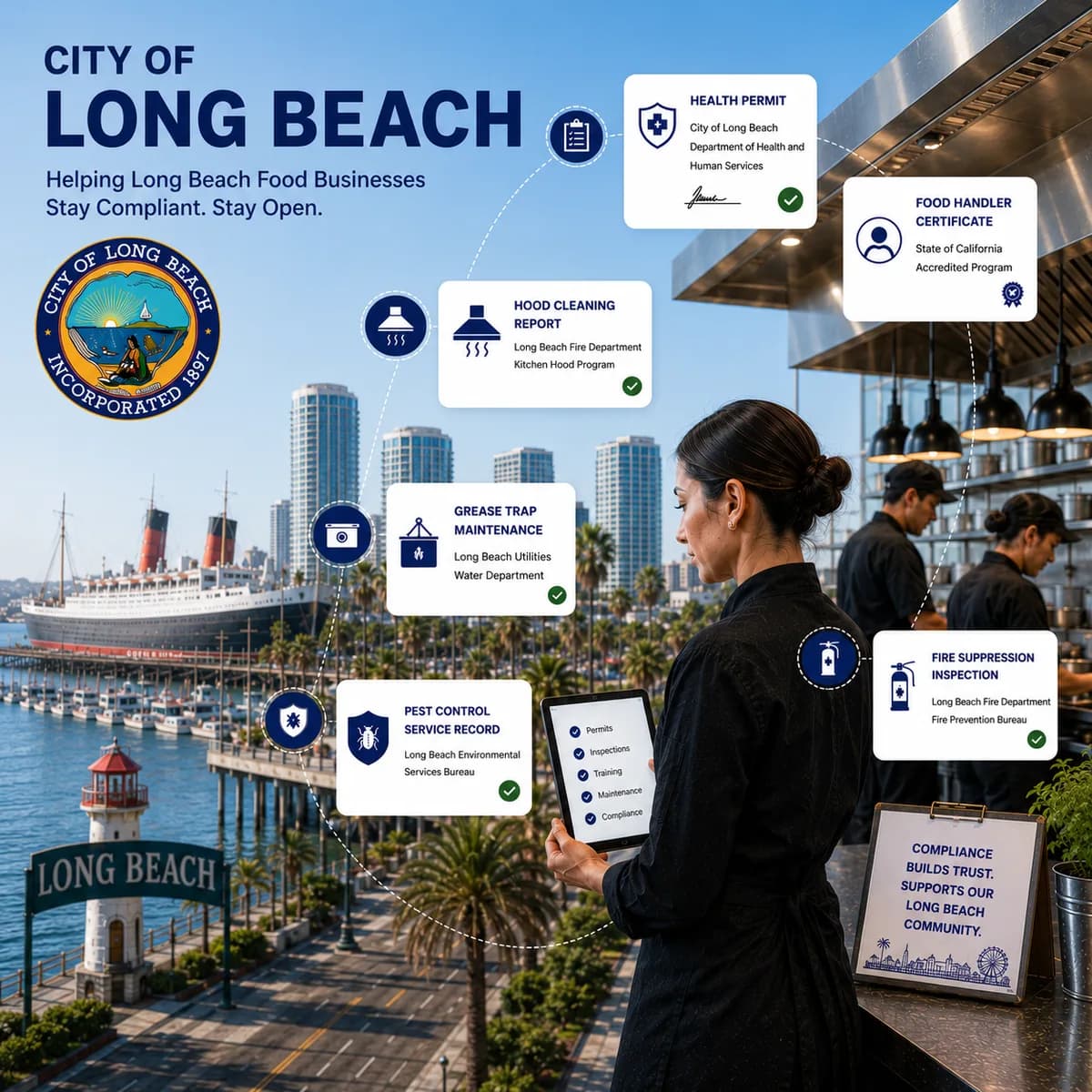
Start with who's actually in charge. Across most of the area, restaurant food safety runs through Los Angeles County Department of Public Health. Long Beach is one of a handful of California cities that never handed that function to its county. It runs its own Department of Health and Human Services, Bureau of Environmental Health, and the county's authority stops at the city line. The county says so itself: it enforces the food code everywhere except Long Beach, Pasadena, and Vernon. So the permit you renew for your Culver City room has nothing to do with your Long Beach room. Different agency, different permit, different inspector, different renewal date. If you're tracking compliance on one calendar, you've already merged two things that don't belong together.
Why there is no letter grade in Long Beach
Then there's the placard. The single most useful thing to internalize about Long Beach is that there is no letter grade. The county's A, B, C system, the one your whole industry instinct is built around, is a county system. Long Beach doesn't assign or post letter grades at all. After a routine inspection, the city posts what it calls an Inspection Summary Report, visible to patrons, and that report stays up until the next routine inspection. When you fix the violations, the city doesn't pull the posting; it adds a notation that corrective action is complete. The practical consequence is that your maintenance and documentation strategy can't be organized around protecting a grade, because there isn't one. It has to be organized around keeping the underlying conditions clean and the paperwork current, because the posting in your window is a narrative summary, not a single reassuring letter.
Who enforces fire code and hood cleaning in Long Beach
Fire is the same story with a different department. Inside Long Beach, the fire authority for your kitchen is the Long Beach Fire Department, not LA County Fire. The city adopts the California Fire Code with its own amendments through Chapter 18.48 of the municipal code, and your hood and exhaust fall under California Fire Code Section 609, which pulls in NFPA 96. None of that frequency table is exotic: monthly for solid fuel, quarterly for high-volume wok and charbroil, semi-annual for moderate sit-down, annual for low-volume. If you run charbroilers hard, you're on a quarterly cycle, same as you'd be most other places. What's different is who's enforcing it and how they want to hear about it.
The Compliance Engine: why a serviced system can still show delinquent
That last part is where Long Beach quietly trips people up. The Long Beach Fire Department doesn't just want your fire-suppression system serviced on schedule. It wants the report filed electronically, through a city portal called The Compliance Engine. The servicing company uploads the inspection and test results, and that upload is what registers your system as compliant in the city's records. Here's the failure mode I've watched happen: a vendor comes out, services the UL-300 system on time, hands the manager a paper certificate, and leaves. The manager files the certificate in a binder, satisfied. Months later a delinquency notice arrives, because nobody uploaded anything to the portal. The work was done. The record didn't exist where the city looks for it. The fix is boring and total: when you book any fire-system service in Long Beach, confirm in writing that the vendor files through The Compliance Engine, and ask for confirmation once they have. That one habit closes the gap.
Coastal corrosion and the maintenance clock
Layer on top of all this the thing the regulations don't mention: the air. Long Beach is a working coastal city, and salt does to kitchen equipment what it does to everything else near the ocean. Condenser coils and fins, hood-fan housings, rooftop unit components, exposed contactors, outdoor compressor cabinets, all of it corrodes faster within reach of the marine layer than it would inland. The equipment that fails first in this city is rarely failing because it was abused. It's failing because the coastal environment is quietly eating it, and an inland maintenance schedule underestimates the wear. Shoreline-adjacent kitchens earn back the cost of more frequent coil rinses and corrosion-protective coatings several times over by not replacing compressors on the coastal clock.
Planning maintenance around the Grand Prix of Long Beach
The calendar has one more Long Beach-specific spike worth planning around. Every April the Acura Grand Prix of Long Beach closes streets through the downtown and shoreline core and floods the surrounding restaurants with concentrated demand. If your kitchen is in that footprint, a walk-in that dies during race weekend is a double problem: you've lost your highest-volume days of the spring, and the streets are closed, so getting a service vehicle to you is harder than usual. Operators who've been through it once learn to run their preventive maintenance in March, clearing anything borderline before the surge, rather than gambling that marginal equipment holds through the busiest weekend in the neighborhood.
What it adds up to
None of this is hard once you know it. The trap is that it's invisible to anyone importing assumptions from elsewhere in the region. Long Beach has its own health department, its own fire department, no letter grade, a fire-report portal that has to be fed, a coastal-corrosion clock, and an April street-closure spike. Five things, all of which sit directly on the maintenance function. Get them onto the right calendar and the city is no harder to operate in than anywhere else. Miss them and you find out the expensive way.
This is the kind of jurisdiction-by-jurisdiction detail that's easy to lose when you're coordinating a dozen separate trade vendors per location and tracking it all by memory and email. Boh, which manages back-of-house repairs, maintenance, and compliance for Southern California restaurants, coordinates the full kitchen trade mix through one point of contact and files the documentation each authority expects as part of closing the work. If you want the city-specific version of how that maps to your rooms, the Long Beach commercial kitchen maintenance overview lays out the local AHJ structure, and the full list of back-of-house trades Boh coordinates shows what falls under a single coverage relationship.
Frequently asked questions
My fire-suppression vendor serviced the system on time but I got a delinquency notice. Why?
Most likely the service was done but never filed through The Compliance Engine, the Long Beach Fire Department's online reporting portal. In Long Beach the upload is what registers the system as compliant, not the paper certificate in your binder. Confirm your servicing vendor files the inspection and test report through the portal and ask for confirmation that it went through.
I run an A-graded restaurant elsewhere in LA County. How do I keep my grade in Long Beach?
You can't, because Long Beach doesn't issue letter grades. The city posts an Inspection Summary Report in your window instead, and it stays posted until your next routine inspection. Plan your operation around keeping conditions clean and documentation current rather than around defending a grade, since there is no grade to defend.
Should I just use my existing county permit for my new Long Beach location?
No. Your LA County Public Health permit has no standing in Long Beach. The city's Bureau of Environmental Health issues and inspects against its own permit, on its own cycle, with its own renewal. A multi-location operator across the city line is maintaining two distinct permit relationships, and treating them as one is how renewal dates and inspection prep get missed.
What's the smartest time to schedule preventive maintenance if I'm near downtown or the shoreline?
Before April. The Acura Grand Prix of Long Beach closes streets through the downtown and shoreline core and concentrates demand into that weekend. Running your PM in March lets you clear borderline equipment ahead of the surge, when a failure costs you peak revenue and a closed-street footprint makes getting a service truck to you harder.
Is coastal corrosion really worth changing my maintenance schedule over?
For shoreline-adjacent kitchens, yes. Salt air accelerates wear on condenser coils and fins, hood-fan motors and housings, rooftop unit components, and outdoor compressor cabinets. More frequent coil rinsing and corrosion-protective coatings cost less over time than replacing compressors and coils on the accelerated coastal failure curve.
Who actually looks at my hood, the health inspector or the fire department?
Potentially both, under separate authorities. A Long Beach Environmental Health inspector can flag hood and exhaust conditions on sanitation grounds, and the Long Beach Fire Department enforces hood and exhaust fire-protection requirements under California Fire Code Section 609 and NFPA 96. NFPA 96 sets the cleaning frequency by cooking volume: monthly for solid-fuel cooking, quarterly for high-volume wok and charbroil lines, semi-annually for moderate-volume sit-down kitchens, and annually for low-volume operations. Keep cleaning certificates and suppression-system test records complete and current so the documentation satisfies either one.
Does Boh handle the Compliance Engine filing for me?
Boh coordinates the fire-suppression service through vetted, CSLB-licensed providers and treats the required documentation as part of closing the work order rather than something you chase afterward. The goal is that the report reaches the city's portal and the record exists where the Long Beach Fire Department looks for it, not just in a binder in your office.
Ready when you are
Running into issues with your kitchen
Our team coordinates vetted technicians across Southern California, same day for emergencies.