
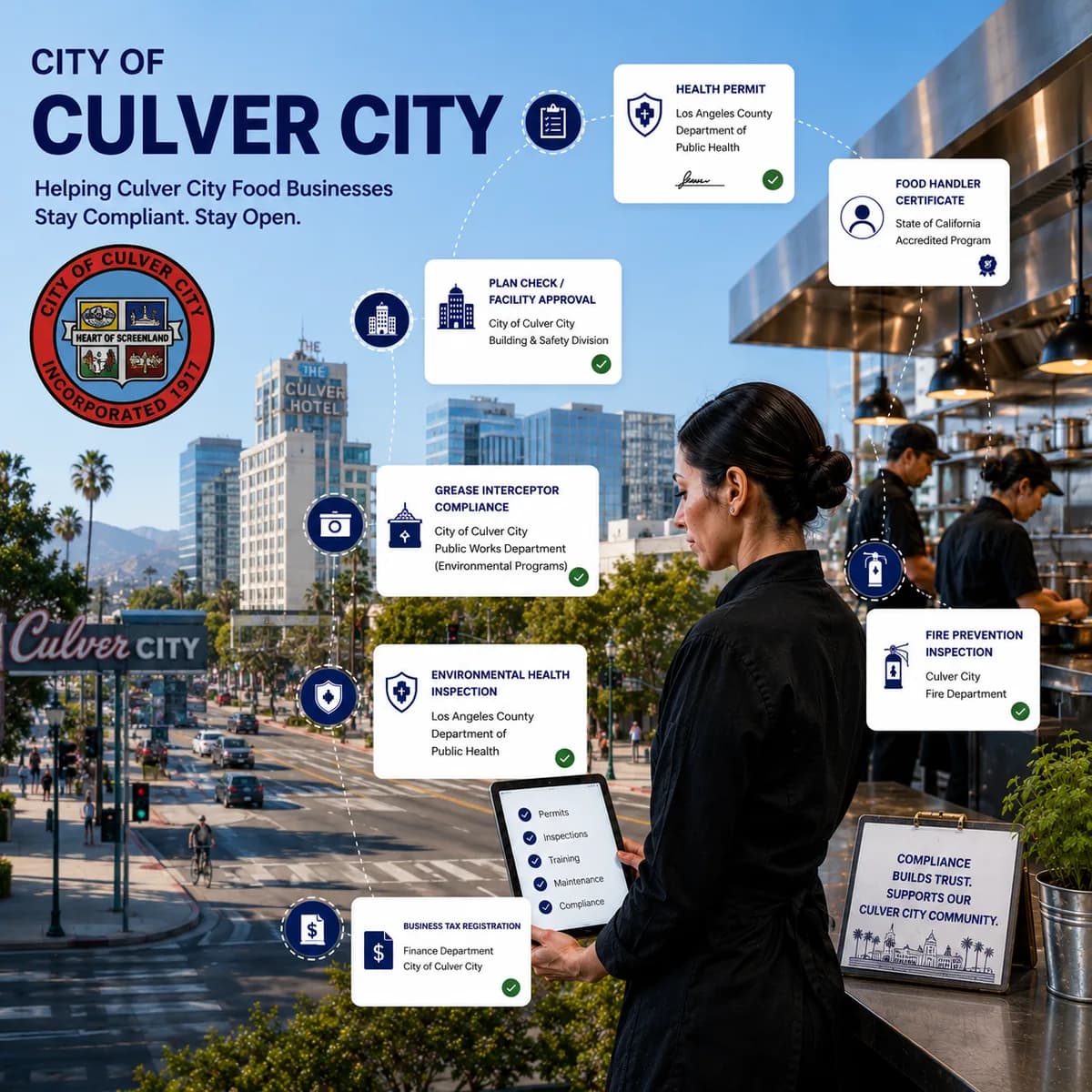
It's a Thursday at 11:40 a.m. in Downtown Culver City, and your line is already deep into the lunch push. The corporate badges started filing in twenty minutes ago, and the weekday rush here has a particular shape: it crests hard at lunch, settles into a five-to-seven happy hour, and then quiets in a way that would surprise anyone who only knows the city by its weekend dinner reputation. Your prep cook flags you down. The walk-in is reading four degrees warmer than it should, and the hood-cleaning company you booked for tonight just called to say their truck can't find a place to set up on Culver Boulevard near the new bus lane. Two problems, two different regulators, one lunch service you can't pause.
This is the part of operating in Culver City that nobody puts in the lease. The food itself is the easy part. The hard part is that you answer to more authorities than a restaurant a few blocks away in the City of Los Angeles does, and the street outside has changed under you.
Fire safety runs through the Culver City Fire Department
Start with the thing most operators get wrong on day one: fire safety in Culver City is not a County matter. The authority having jurisdiction is the Culver City Fire Department, which runs its own Community Risk Reduction Division. That division does your commercial plan check, your annual fire inspection, and the permits tied to your cooking and suppression systems, all in-house. If you came up working in unincorporated County territory or in another County city served by LA County Fire, this is a genuine change of address for your paperwork. The governing reference is the Culver City Municipal Code, Title 9, Chapter 9.02, which adopts the California Fire Code with local amendments. The city moved to the 2025 California Fire Code under that chapter in October 2025, so if your last build-out was permitted under an older code cycle, the version on the books today is newer than the one in your files.
What that means in the kitchen is concrete. Your hood and exhaust system lives under NFPA 96, which sets cleaning frequency by how much you cook and what you cook with. Your wet-chemical suppression system over the line lives under NFPA 17A and the UL 300 standard, with semiannual service. None of that is unique to Culver City. What is local is who signs off and where the records go: the Culver City Fire Department, not the County. When an inspector walks in, the hood-cleaning certificate and the suppression-system service tag they want to see are the ones that match the city's expectations, and the smart move is to have them filed before anyone asks, not chased after a citation.
Food safety runs through LA County
Now the second regulator, because food safety runs on a completely separate track. Here Culver City does fall under Los Angeles County. Unlike Pasadena and Long Beach, which run their own health departments, Culver City has no health department of its own. Your food inspections come from the LA County Department of Public Health, Environmental Health, under the California Retail Food Code, and you post the County letter grade in your window. The math is worth memorizing because your staff will ask: every inspection starts at 100 points, an A is 90 to 100, a B is 80 to 89, a C is 70 to 79, and anything 69 or below means you post a numeric score card instead of a letter. If you noticed your A card looks a little different than it used to, that's real: the County refreshed the placard colors over the past few years, and the A is green now rather than the old blue. The thresholds didn't move, only the paint.
So before you've plated a single dish, you're tracking two separate compliance calendars from two separate authorities, with two separate sets of records an inspector can ask to see. That alone is more overhead than a lot of operators budget for.
The MOVE Culver City curb redesign
Then there's the street. The MOVE Culver City project rebuilt Culver Boulevard and Washington Boulevard in Downtown Culver with dedicated bus and bike infrastructure. The early version of the project took a vehicle lane, drew a lawsuit, and got modified: after a 2024 redesign, the city restored a second general-purpose lane where it could by folding the bus and bike lanes into shared bus/bike lanes. The headline version of the story is "they put the lane back." The operator version is more specific. Curb parking and loading staging along parts of the corridor were reconfigured, and that's exactly the curb your service vendors need. A hood-cleaning truck needs extended curb space and a clear path to run hoses. A refrigeration tech wants a loading zone close to the back door for a fast parts swap. A grease pump-out rig needs room to set up. When the curb gets tighter, every one of those calls absorbs staging time that doesn't show up until the truck is circling the block while your walk-in keeps warming.
That's why the walk-in alarm and the hood truck's parking problem are really the same problem. Both are about how fast the right licensed person can actually get to your equipment, and in Downtown Culver, "getting there" now includes a curb that fights back.
A high-pressure submarket
The submarket itself raises the stakes. The tech-and-studio money reshaped what this neighborhood eats and when. Apple is building its roughly 536,000-square-foot Culver Crossings campus on the Culver City and Los Angeles border, part of a stated goal to grow its L.A.-area office to more than 3,000 employees. Warner Bros. Discovery sits on 240,000 square feet at Ivy Station, and Amazon holds a large footprint around Culver Studios. That's an enormous, concentrated weekday lunch demand sitting on top of a neighborhood dinner scene, and it compresses your equipment-recovery window. The Helms Design District tells the other half of the story: the Helms Bakery revival opened in November 2024 and closed about a year later, H.D. Buttercup and the schnitzel spot Lustig departed, and a new wave moved in, with IKEA's first city-center store in Los Angeles, which opened in the complex in spring 2026, alongside Hayama by WATAMI and the now-open Folks Pizzeria. Downtown also lost Citizen Public Market, the food hall that closed on November 2, 2025 after a five-year run. The district is mid-transition, and operators near the construction footprint are working through access changes on top of everything else.
Set up the relationship before you need it
The practical takeaway is the same one a good operator reaches on their own after the second bad emergency: the day you need a refrigeration tech at 11:40 a.m. on a Thursday is not the day to be explaining your address, your equipment, and your loading situation to someone who has never been to your kitchen. The friction in Culver City is not really regulatory complexity or a redesigned curb in isolation. It's that all of it lands at once, and the people who handle it well are the ones who set up the relationship before they needed it.
Boh, which manages back-of-house repairs, maintenance, and compliance for Southern California restaurants, coordinates vetted, third-party CSLB-licensed providers across the full kitchen trade mix, so the fire-side and food-side documentation gets produced and filed as part of closing the work order rather than chased afterward. If you operate in the neighborhood, the Culver City commercial kitchen maintenance overview lays out the local authorities and coverage in one place, and the full list of back-of-house trades Boh coordinates shows what can run under a single point of contact.
Frequently asked questions
If my kitchen passes its County health inspection, am I clear with the Culver City Fire Department too?
No. They are separate authorities checking separate things. The LA County Department of Public Health handles food safety and your letter grade, while the Culver City Fire Department handles fire and life safety through its Community Risk Reduction Division, including your hood system, suppression system, and cooking-related permits. Passing one says nothing about the other. You need clean records on both tracks, and an inspector from either authority can ask to see them independently.
My last build-out was permitted years ago. Does the 2025 fire code adoption affect me now?
It can matter most when you renovate, change your cooking line, or trigger a new plan check. Culver City adopted the 2025 California Fire Code with local amendments under Municipal Code Chapter 9.02 in October 2025, so any new permitted work is reviewed against the current cycle, not the one your original build-out used. Existing systems are generally maintained to the code they were installed under, but it's worth confirming with the Culver City Fire Department before you assume an older configuration still complies, especially for suppression and ventilation.
How do I keep a hood-cleaning truck from getting stuck on the MOVE Culver City corridor?
Plan the staging before the truck arrives. The redesigned Culver and Washington Boulevard corridor reconfigured curb parking and loading in parts of Downtown Culver, so a vendor showing up cold may circle looking for space. The fix is having the loading approach, the nearest usable curb, and the hose-run path documented as part of your site profile so the crew knows where to set up before they leave the yard. Off-peak scheduling helps too, since curb competition is worst during the lunch and happy-hour crush.
What score do I actually need to keep an A in my window in Culver City?
A score of 90 to 100 out of 100 earns an A under the LA County system that Culver City uses. An 80 to 89 is a B, a 70 to 79 is a C, and 69 or below means you post a numeric score card instead of a letter. Inspections start at 100 and deduct for violations, so an A is about controlling the count and severity of deductions. The placard colors were refreshed by the County recently, so a current A card is green, but the scoring is the same as before.
I'm opening a second Culver City location. What changes operationally versus my first?
Your regulators don't change, but your coordination load doubles, and the two sites may sit in different curb-access situations along the MOVE corridor. The biggest operational risk with a second location is running two separate sets of fire and food-safety records, two PM calendars, and two rosters of trade vendors with no shared system. Consolidating the back-of-house trades under one coordinated relationship keeps the documentation and dispatch consistent across both kitchens, which is the difference between one calendar to watch and several.
A walk-in is climbing in temperature during lunch service. What's the first move?
Protect the product and the record at the same time. Move the most temperature-sensitive items to your most reliable backup refrigeration, note the time and temperature readings, and get a refrigeration tech dispatched immediately rather than waiting to see if the unit recovers. In Culver City, factor the curb-access reality into your call: tell whoever is dispatching exactly where the tech should stage, because in Downtown Culver that can decide whether help arrives in minutes or after a few laps around the block. An established maintenance relationship shortens all of this because your equipment and access details are already on file.
Ready when you are
Running into issues with your kitchen
Our team coordinates vetted technicians across Southern California, same day for emergencies.