
In this article · 6 sections
It's the moment that surprises operators most: you've run restaurants across Los Angeles for years, you submit your permit paperwork for a new Pasadena location, and the city tells you your LA County health permit doesn't apply here. Not as a formality. It genuinely doesn't apply, because Pasadena isn't under LA County's jurisdiction for food safety at all.
Does an LA County health permit work in Pasadena?
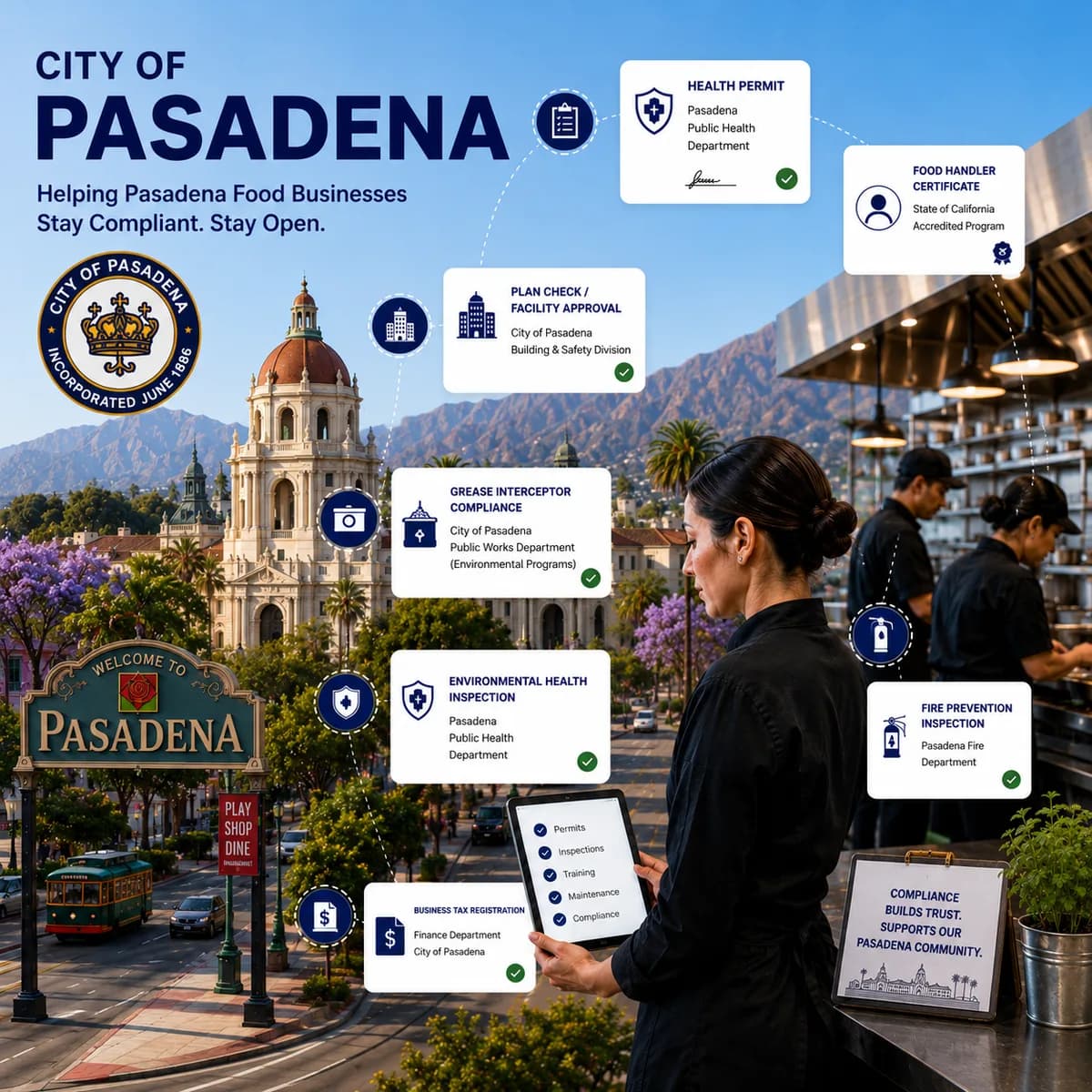
No. An LA County health permit does not authorize a restaurant to operate in Pasadena. The city is one of only a few in California, and one of three in Southern California, alongside Long Beach and Vernon, that runs its own health department independent of the county. For most of the region, the Los Angeles County Department of Public Health is the food-safety authority everywhere. Pasadena is a carve-out. The Pasadena Public Health Department issues its own permits, runs its own plan checks, and sends its own inspectors. An operator moving in from West LA or downtown doesn't transfer a county permit; they start a separate process with a separate authority, separate fees, and a separate inspector roster.
That single fact cascades into almost everything else about running a kitchen in Pasadena, and the operators who get caught out are usually the experienced ones who assume the county playbook carries over.
What do Pasadena restaurant inspection placards mean?
The placard on your window won't say A. If you're used to the LA County system, you're used to the letter grade: an A, B, or C card taped to the front window. Pasadena doesn't use it. The city posts a PASS, CONDITIONAL PASS, or CLOSED placard instead, scored on a 100-point scale.
Here's how the scoring actually works, because the numbers matter and they're easy to get wrong. An initial inspection scoring 85 or above earns a PASS. A score of 75 to 84 is a CONDITIONAL PASS, which is not a pass you can sit on: it triggers a follow-up inspection within five working days, and at that follow-up you need to score 95 or above to clear back to a PASS. A CLOSED placard means exactly what it says, the facility stops operating until the violations are corrected.
The practical takeaway is that a CONDITIONAL PASS in Pasadena puts you on a five-day clock with a higher bar to clear than the one you just missed. There's no coasting on a B-equivalent the way an operator might mentally file a county B grade. The system is built to force correction fast.
Who enforces restaurant fire code and hood cleaning in Pasadena?
The jurisdictional split isn't only about health. For commercial kitchen fire safety, the authority having jurisdiction in Pasadena is the Pasadena Fire Prevention Bureau, and it operates independently of LA County Fire. It enforces NFPA 96, the national standard for kitchen exhaust cleaning, on its own inspection calendar, under Pasadena Municipal Code Title 14, Chapter 14.28.
For an operator, that means two separate authorities, health and fire, each with its own schedule, its own documentation expectations, and its own enforcement, neither of which talks to the county version you might know. A hood cleaning that satisfies one doesn't automatically register with the other, and a missed cleaning can draw attention from the fire side independent of anything the health side does.
Old Town's historic buildings are their own compliance problem
There's a Pasadena-specific wrinkle that doesn't show up in the code books but shows up constantly in inspections. A large share of Old Town's restaurants occupy historic buildings, the 22-block stretch along Colorado Boulevard that's a National Register Historic District, full of carefully restored early-twentieth-century construction.
The problem is that exhaust ductwork in these buildings was almost always retrofitted, not designed in. Duct routing runs through walls and chases that were never meant to carry it, and access panels are scarce. NFPA 96 requires that the entire exhaust system be cleaned, and Pasadena Fire Prevention Bureau inspectors pay particular attention to whether every section of duct can actually be reached and was actually cleaned. The recurring citation isn't "the hood is dirty." It's "you can't demonstrate that the hidden runs of duct behind that 1920s brick wall were accessed." The cleaning may have been done correctly and still fail to satisfy the inspector if the access documentation isn't there.
For operators in Old Town, that turns hood cleaning from a routine line item into something that needs a provider who understands the building stock and documents access section by section. Newer construction along East Colorado and the corridor beyond Old Town doesn't carry the same burden.
The Rose Parade closes your street for a day
Every operator on or near the parade route learns this once. Colorado Boulevard closes to vehicles at 10pm on December 31 for Rose Parade staging and doesn't reopen until roughly 2pm on January 1. During that window, restaurants on the route can't take vendor deliveries, can't get a grease trap pumped, and can't schedule non-emergency service. Anyone who needs to reach your building has to arrive before the 10pm closure or park outside the restricted zone and walk in.
If you run a kitchen near the route, the maintenance implication is simple but easy to forget in the holiday rush: anything you'd normally schedule for that turn of the calendar, a grease pumpout, a deep clean, a refrigeration check, needs to land before the closure or wait until after the route clears. Build it into your December planning, because the one year you forget is the year your grease trap is due on January 1.
What this adds up to
None of these differences is exotic on its own. Together they mean that running a restaurant in Pasadena requires a genuinely different compliance map than running one anywhere else in the region: a city health department instead of the county, a placard system instead of letter grades, an independent fire authority, historic-building access requirements, and an annual operational shutdown most calendars don't account for. The operators who struggle are the ones who assume their county experience transfers. The ones who do well treat Pasadena as its own jurisdiction, because that's exactly what it is.
This is the kind of coordination Boh, which manages back-of-house repairs, maintenance, and compliance for Southern California restaurants, handles for operators across the city, scheduling service to the right authority's requirements and filing the documentation each one expects after every visit. You can see the full picture of restaurant maintenance in Pasadena, or book a service directly.
Frequently asked questions
I already run restaurants in LA County. What changes when I open in Pasadena?
The biggest change is that Pasadena runs its own health department, so your LA County health permit doesn't apply within Pasadena city limits. You start a separate permitting process with the Pasadena Public Health Department, including its own plan check, fees, and inspectors. Pasadena also uses a different inspection placard and a separate fire authority, so the county compliance routine you're used to doesn't carry over.
What score do I need to pass a Pasadena health inspection?
An initial inspection scoring 85 or above on Pasadena's 100-point scale earns a PASS placard. A score of 75 to 84 is a CONDITIONAL PASS, which requires a follow-up inspection within five working days, and at that follow-up you need 95 or above to return to a PASS. A score that triggers a CLOSED placard means the facility must stop operating until violations are corrected.
Why do hood cleanings fail inspection in Old Town Pasadena even when the cleaning was done?
Many Old Town buildings are historic, with exhaust ductwork retrofitted into early-twentieth-century construction where access panels are scarce. NFPA 96 requires the entire exhaust system to be cleaned, and Pasadena Fire Prevention Bureau inspectors look for documentation that every section of duct was accessed, including hidden runs. A cleaning can be done correctly and still draw a citation if you can't demonstrate access to the full system.
How should I plan restaurant maintenance around the Rose Parade?
Colorado Boulevard closes to vehicles at 10pm on December 31 and reopens around 2pm on January 1 for Rose Parade staging. If your restaurant is on or near the route, you can't receive deliveries, grease pumpouts, or non-emergency service during that window. Schedule anything due around the new year before the closure or after the route clears.
Who enforces fire code and hood cleaning in Pasadena?
In Pasadena the fire authority is the Pasadena Fire Prevention Bureau, which operates independently of LA County Fire. It enforces NFPA 96 for kitchen exhaust cleaning on its own inspection calendar under Pasadena Municipal Code Title 14, Chapter 14.28. A hood cleaning that satisfies a county jurisdiction doesn't automatically register with Pasadena's fire authority, so operators expanding in from elsewhere in the region are starting a separate fire-compliance relationship, not transferring one.
What happens if I get a CONDITIONAL PASS in Pasadena?
A CONDITIONAL PASS is an initial score of 75 to 84 on Pasadena's 100-point scale, and it puts you on a five-working-day clock: the city returns for a follow-up inspection, and you need to score 95 or above to clear back to a PASS. The bar at the follow-up is higher than the one you just missed, so a CONDITIONAL PASS isn't a grade you can operate on comfortably the way an operator might mentally file a county B — the system is built to force fast correction.
Is hood cleaning more expensive or complicated in Old Town Pasadena?
Often more involved, because of the building stock rather than the city's rules. Much of Old Town sits in a 22-block National Register Historic District where exhaust ductwork was retrofitted into early-twentieth-century construction, with duct runs through walls and chases and scarce access panels. NFPA 96 requires the entire system be cleaned, and Pasadena Fire Prevention Bureau inspectors look for documentation that every section, including hidden runs, was accessed. That favors a provider who knows the building type and documents access section by section, which can affect both scheduling and cost.
Ready when you are
Running into issues with your kitchen
Our team coordinates vetted technicians across Southern California, same day for emergencies.