
It is 4:40 a.m. on Santa Monica Boulevard and you are standing in your own walk-in with a flashlight, because the box crept up to 47 degrees overnight and you have a brunch service in five hours. You called your refrigeration guy at 1 a.m. when the line cook texted you the temp. He is coming. The question is whether he gets here, finds parking on a block where the loading zone turns into a no-stopping zone at 6, and is done before your produce delivery double-parks behind his van. In West Hollywood, the repair is rarely the hard part. The choreography around the repair is the hard part.
Why West Hollywood is its own regulatory world
If you have operated in the City of Los Angeles and then opened a second unit a few blocks west, the first thing that surprises you is that almost nothing about the regulatory map carries over. West Hollywood is its own incorporated city, all 1.9 square miles of it, and it is what is called a contract city: it runs no fire department and no police department of its own. It contracts fire protection to the Los Angeles County Fire Department and law enforcement to the Los Angeles County Sheriff's Department. That single structural fact reshapes how your back-of-house compliance actually works.
Fire: your authority is LACoFD, not LAFD
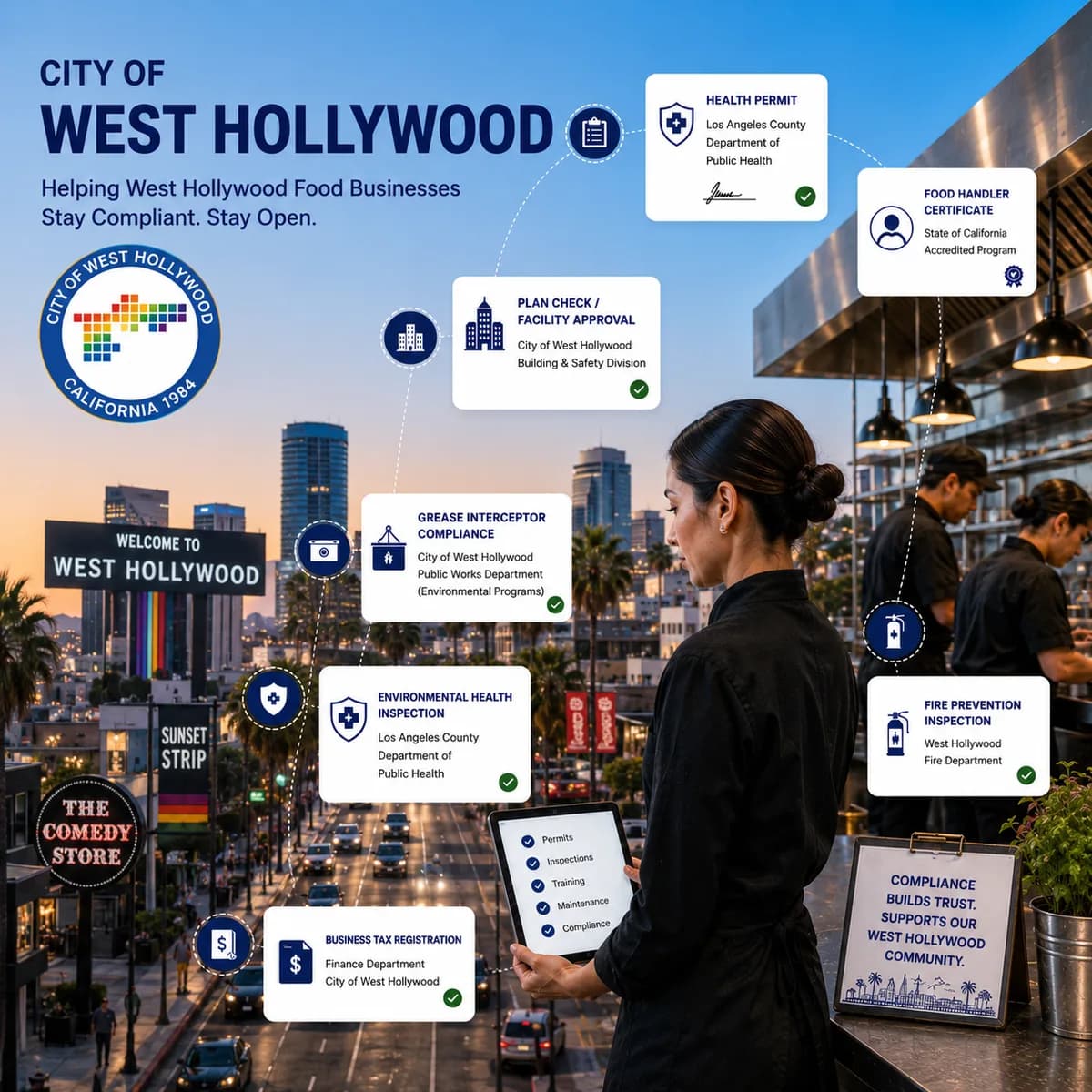
Start with fire, because that is the one that touches your hood, your suppression system, and your annual headaches. Your authority having jurisdiction is LACoFD, not LAFD. The two departments are not interchangeable from a paperwork standpoint. They have different inspectors, different permit forms, and different scheduling systems. The local code lives in West Hollywood Municipal Code Title 14, Fire Protection, which adopts the County Fire Code (Los Angeles County Code Title 32) by reference. In plain terms, your NFPA 96 hood-cleaning cadence, your NFPA 17A suppression service on a UL-300 system, your grease-handling documentation: all of it gets enforced by County fire personnel operating out of Station 7 and Battalion 1 headquarters at 864 North San Vicente Boulevard. If you have a sister location inside LA city limits, or in Santa Monica, you are quietly running two fire-compliance relationships in parallel, and the documentation that satisfies one inspector roster is filed in a different system than the other. Operators who treat "the Eastside units" and "the WeHo unit" as one compliance workflow are the ones who get caught flat-footed at renewal.
Health: the familiar County letter grade
Health is a cleaner story, because it is the same authority most of the region uses. Your inspections come from the Los Angeles County Department of Public Health, Environmental Health Division, under the California Retail Food Code. It is the familiar letter-grade placard: A is 90 to 100, B is 80 to 89, C is 70 to 79, and anything under 70 gets you a numeric score card instead of a letter, posted where the public can see it until your next routine inspection. The grading does not change because you crossed into West Hollywood. What changes is everything around it.
The clock: a 2 a.m. close and a five-hour window
Then there is the clock. California sets last call at 2 a.m. statewide, and West Hollywood lives close to that line every night. The bar programs are dense, the rooms run late, and the kitchens behind them close late. Every few years a bill surfaces to let certain California cities push last call to 4 a.m., West Hollywood is usually named, and every time it dies in Sacramento. So plan around 2 a.m. as a permanent fixture. The operational consequence is the thing that defines maintenance here: your preventive-maintenance window is brutal. A kitchen that closes in the small hours and reopens for daytime service has maybe a five-hour gap, and most of it goes to closing duties and prep. Functional access for a tech to pull a panel, clean a coil, or run a hood is closer to the 4 a.m. to 9 a.m. slot, and that window does not stretch. The vendor who knows your gate code and your alley at 5 a.m. is worth more than the one with a lower hourly rate who needs twenty minutes to figure out where to park.
The curb is a managed resource
Which brings up the most underrated operational fact about this city: the curb is a managed resource. In 1.9 square miles with this restaurant density, loading zones are scarce, time-restricted, and frequently held against valet contracts. A hood-cleaning truck cannot just idle on the boulevard. A refrigeration van staging at 5 a.m. is competing with deliveries, sanitation, and the morning's first valet setup. The practical effect is that a cold-call vendor loses real time just getting positioned, and time is the one thing your pre-dawn window does not have. This is where having your site-access details, your equipment list, and your asset history already on file stops being a nice-to-have. It is the difference between a tech who starts working at 4:50 and a tech who is still circling the block at 5:15.
The smoking ordinance operators miss
One more city-specific item that catches new operators: the smoking ordinance. West Hollywood prohibits smoking within five feet of outdoor dining areas, and if you intend to allow smoking anywhere on your premises you have to file a Smoking Operations Plan with the city. Bars and nightclubs are exempt from the outdoor-dining piece, which is exactly the kind of distinction that trips up a hybrid room that serves food early and drinks late. It is not a kitchen-equipment rule, but it is a citation waiting to happen if your patio signage is wrong.
The layered compliance reality
None of this is a reason to avoid West Hollywood. It is one of the strongest restaurant markets in Southern California. But it rewards operators who understand that the city's compliance reality is a layered one: County fire enforcing a County fire code, County deputies on the public-safety side, County public health on the grade card, a state last-call limit, and a set of local ordinances stacked on top, all inside a footprint you can walk across in half an hour. The operators who thrive here are the ones who stop treating maintenance as a series of one-off emergencies and start treating it as a managed relationship that already knows their building before the walk-in climbs to 47 degrees.
That is the case for consolidating back-of-house under one coordinated network rather than a binder full of separate trade vendors. When the asset register, the access protocol, and the compliance documentation are already on file, the pre-dawn window stops being a scramble. To see how Boh covers the city specifically, the West Hollywood commercial kitchen maintenance page lays out the trades and the local AHJ structure, and the full list of back-of-house services shows what gets coordinated under a single point of contact.
Boh, which manages back-of-house repairs, maintenance, and compliance for Southern California restaurants, coordinates vetted CSLB-licensed trades through one work order, with hood-cleaning certificates, NFPA 17A records, and refrigeration logs filed as part of closing the job rather than chased down later.
Frequently asked questions
If I run a unit in West Hollywood and another in the City of Los Angeles, are my fire inspections the same?
No. West Hollywood contracts fire protection to the Los Angeles County Fire Department, so your West Hollywood unit is inspected and permitted by LACoFD under the County Fire Code adopted in West Hollywood Municipal Code Title 14. A unit inside Los Angeles city limits answers to the Los Angeles Fire Department instead. They use different inspectors, different permit forms, and different scheduling systems, so you are effectively maintaining two separate fire-compliance relationships even if the two kitchens are blocks apart.
What is a realistic preventive-maintenance window for a West Hollywood kitchen?
For a late-service kitchen, plan on roughly 4 a.m. to 9 a.m. California's 2 a.m. last call keeps the bar-and-restaurant core running late, and once you account for closing duties and morning prep, the genuinely workable access window for non-emergency maintenance is about five hours. Coil cleaning, hood service, and panel work all have to fit inside it, which is why scheduling and vendor familiarity matter more here than raw hourly rate.
Why does curb and loading access keep coming up as a maintenance problem in West Hollywood?
Because the city is only 1.9 square miles with an exceptionally high restaurant density, curb space is tightly managed. Loading zones are scarce and time-restricted, and valet contracts hold premium curb space. A service vehicle staging before dawn competes with deliveries and valet setup, so a vendor unfamiliar with your block loses real time just getting positioned, which eats directly into the short pre-dawn maintenance window.
Does the West Hollywood smoking ordinance affect my restaurant's back-of-house?
Not the equipment directly, but it affects your operation. West Hollywood bans smoking within five feet of outdoor dining areas, and any business permitting smoking on its premises must file a Smoking Operations Plan with the city. Bars and nightclubs are exempt from the outdoor-dining provision. It is primarily a signage and operations requirement, but it is a common citation trap for rooms that serve food and drink under different parts of the day.
Who do I call first when a walk-in starts climbing overnight in West Hollywood?
Call your refrigeration coordination path immediately rather than waiting for morning, because your usable repair window before service is narrow. The advantage of a maintenance relationship that already has your equipment list, site access, and alley and gate details on file is that the technician can start working the moment they arrive instead of spending the first part of a five-hour window onboarding. With a cold-call vendor in a city this access-constrained, that onboarding overhead can cost you the whole window.
Ready when you are
Running into issues with your kitchen
Our team coordinates vetted technicians across Southern California, same day for emergencies.