
In this article · 8 sections
- What does an inspector actually check on a hood-cleaning record?
- What's the difference between a hood-cleaning certificate and an inspection report?
- Does a hood-cleaning contractor need a specific CSLB license?
- How often does NFPA 96 require commercial-kitchen hood cleaning?
- How long should hood-cleaning records be retained, and how should they be stored?
- What does an audit-defensible hood-cleaning documentation chain actually look like?
- How do I check my own hood-cleaning documentation this week?
- References and standards
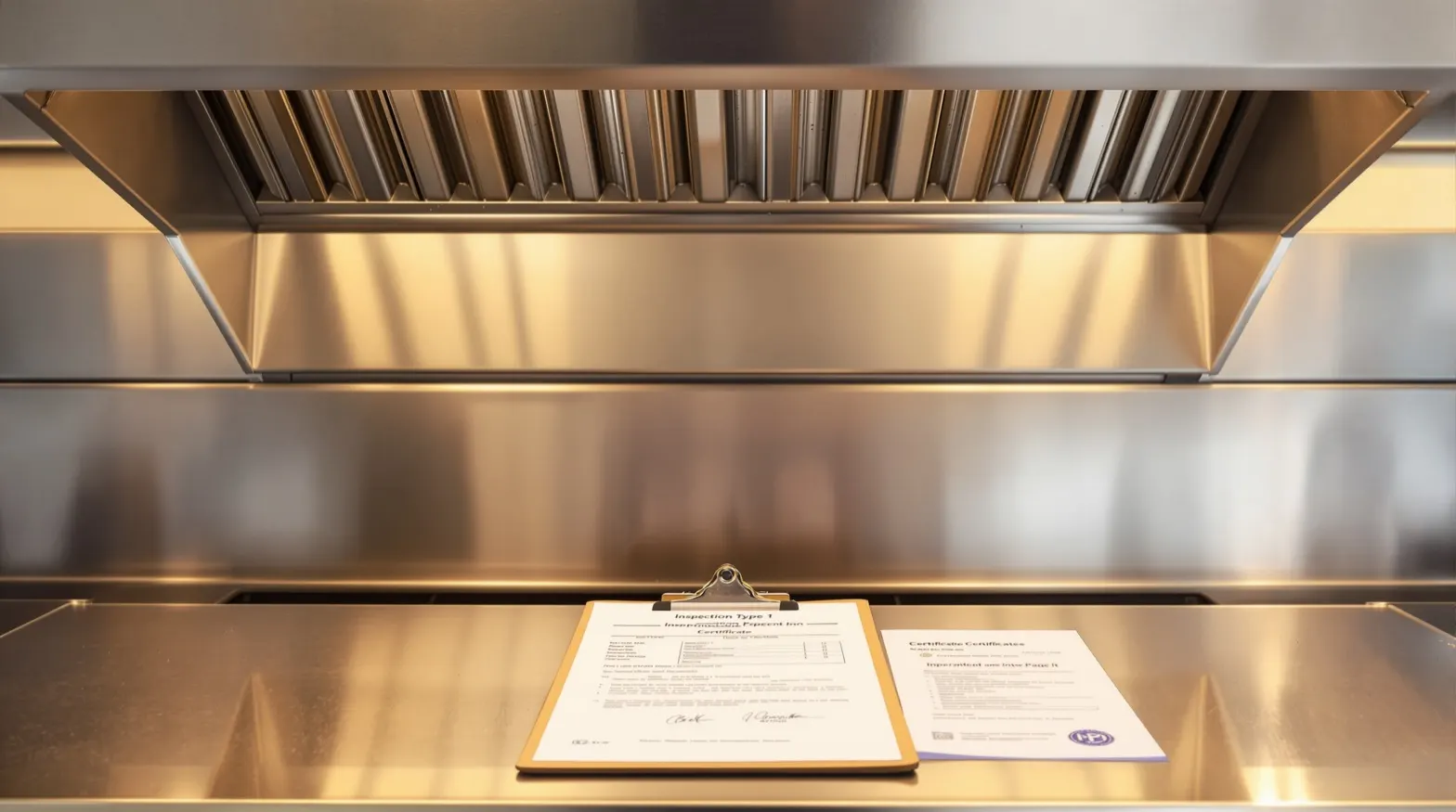
It's a Tuesday morning. The fire marshal walks into your Studio City location with a clipboard, points at the Type 1 hood, and asks for the cleaning report. You hand over the certificate the vendor emailed you last quarter. He reads it, makes a note, and writes you up for incomplete documentation. The hood is clean. The vendor did the work. You paid the invoice. None of that is what he's writing about.
This is the gap most restaurant operators don't see until they hit it. The hood cleaning happens on cadence. The vendor produces a certificate. The kitchen manager files it. From the operator's perspective the compliance work is done. From the fire marshal's perspective there's a difference between a certificate that proves a cleaning occurred and a report under NFPA 96's recordkeeping requirements that documents what the cleaning found, what was accessible, what wasn't, and what the contractor recommends. (NFPA 96 is revised periodically, so confirm the edition your AHJ enforces, as section numbering changed in the 2021 and 2024 editions.) The certificate is the lower bar. The report is what's audit-defensible. The two often come from the same vendor but they're different documents, and operators routinely keep one without the other.
Define your terms
Hood-cleaning certificate: the basic artifact a hood-cleaning vendor produces stating that a cleaning was performed, typically including date, location, and contractor name. Cleaning inspection report (NFPA 96's recordkeeping requirements): the more substantive document that records the contractor's findings during the cleaning, including areas accessible, areas inaccessible, deficiencies observed, and recommendations. AHJ (authority having jurisdiction): the local body that enforces NFPA 96, usually the fire marshal, sometimes coordinating with the local environmental-health department.
What does an inspector actually check on a hood-cleaning record?
Three things at minimum: that the cadence matches what the AHJ requires for your cooking volume under NFPA 96, that the contractor is properly qualified (NFPA 96 requires the work be done by a person or company that is trained, qualified, and certified, acceptable to the authority having jurisdiction, with IKECA the recognized industry credential), and that the documentation contains the required fields: date, location, ductwork accessibility, areas not cleaned and why, contractor signature or stamp.
The cadence verification is the most visible check. If your cooking volume places you in the NFPA 96 quarterly band and your last cleaning was eight months ago, the cadence has lapsed regardless of what the certificate says. The contractor-qualification verification is the second check: inspectors look for evidence that the contractor is trained, qualified, and certified, acceptable to the AHJ, and the certificate should carry the contractor's license number, status, and bond so that status can be confirmed at the moment you receive the document. The third check is the fields inside the documentation itself: a certificate that lists only "hood cleaned by Vendor X on date Y" without specifying scope, access limitations, or findings is functionally incomplete, even if the cleaning was thorough. NFPA 96's recordkeeping requirements specify what should be in the report. Inspectors who know the standard look for those fields.
The asymmetry matters. The fire marshal has finite time on-site and is making a quick judgment about whether your documentation chain is intact. A complete report with the right fields in the right order signals an operator who runs a compliant program. A bare certificate signals an operator whose vendor is producing minimum-viable paperwork. The first read passes the visit; the second triggers a closer look.
What's the difference between a hood-cleaning certificate and an inspection report?
A certificate documents that the cleaning happened. A cleaning inspection report under NFPA 96's recordkeeping requirements documents what the cleaning found: access, scope, deficiencies, recommendations. Many operators have a certificate but not the report. Inspectors increasingly ask for the report.
The conceptual difference is "did the work happen" versus "what did the work find." The certificate is a receipt. The report is an inspection narrative. NFPA 96's recordkeeping requirements specify that a written report be produced and made available to the AHJ; the report contains the inspection findings during the cleaning, including any areas of the hood, duct, or fan that were inaccessible (a common condition in older buildings or buildings with restricted ceiling space), any deficiencies observed (deteriorated welds, broken fan parts, gaps in ductwork, accumulated grease past the access points), and recommendations for follow-up work or scope expansion. A vendor doing the minimum produces a certificate; a vendor doing the standard properly produces a certificate plus a report.
The two documents are sometimes combined: some vendors produce a single "cleaning report and certificate" document that satisfies both functions. Other vendors produce only the certificate and provide the report on request. The operational risk is that an operator who has been paying for cleanings for years may have a folder of certificates and no reports at all, which is fine until the AHJ asks for the report. At that point the operator has to go back to the vendor and ask for documentation that may or may not still exist in the vendor's system, depending on the vendor's record-keeping practice.
Does a hood-cleaning contractor need a specific CSLB license?
There is a common misconception that hood cleaning maps to a specific CSLB specialty classification. It does not. The CSLB classification system has no subcategory that names kitchen-exhaust or hood cleaning. What actually governs the work is NFPA 96, which requires the cleaning to be performed by a person or company that is trained, qualified, and certified, acceptable to the authority having jurisdiction. The recognized industry credential is certification from IKECA (the International Kitchen Exhaust Cleaning Association). When you vet a hood-cleaning provider, ask for IKECA certification and proof of training rather than a CSLB "D" subcategory number, and confirm what your local AHJ accepts, since requirements vary by jurisdiction.
The day-to-day important thing is verification, and the certificate is where it lives. The contractor's license number, status, and bond should appear on every certificate. The number lets you check the contractor's status, bond, and complaint history at the moment you receive the document, which is what the fire marshal will do during an audit. Operators who don't have that information on their certificates can't perform this check, which means they can't catch a problem until the AHJ catches it for them.
The bond status matters because a bonded contractor carries financial accountability for incomplete or substandard work. A bond claim is the operator's recourse if the cleaning later turns out to have been performed below standard, which is rare but possible, especially on inaccessible duct runs that the vendor didn't actually clean despite documenting that they had. Operators should confirm specific contractor qualification, IKECA certification, and bonding with their local AHJ, particularly when onboarding a new vendor or evaluating an existing one.
How often does NFPA 96 require commercial-kitchen hood cleaning?
NFPA 96 sets an inspection schedule based on cooking volume that determines how often the system is inspected and cleaned: monthly for the highest-volume operations, quarterly for moderate volume, semi-annual for lower volume, and annual for the lowest-volume operations. Most Southern California full-service and quick-service restaurants land in the quarterly or semi-annual band based on volume. The AHJ sets the specific cadence for your specific location.
The cooking-volume bands NFPA 96 describes include solid-fuel cooking (which carries its own more aggressive cadence due to creosote buildup), high-volume cooking like 24-hour operations or heavy charbroil concepts, moderate-volume cooking covering most commercial restaurants in normal operating hours, and low-volume cooking like seasonal or limited-hour businesses. A casual full-service restaurant running dinner service five nights a week with a moderate fryer load is typically in the quarterly or semi-annual band. A QSR running heavy fryer and charbroil throughput across breakfast, lunch, and dinner is typically in the monthly or quarterly band. A bakery or coffee operation with limited cooking equipment is typically in the annual or semi-annual band.
The translation from volume band to cadence is the AHJ's call. The local fire marshal applies the NFPA 96 framework to your specific cooking-volume profile and may also factor in insurance-carrier requirements and previous inspection history. Operators should confirm specific cadence in writing, either through their AHJ permit conditions or their fire-marshal correspondence, and not rely on a national-average number.
How long should hood-cleaning records be retained, and how should they be stored?
NFPA 96's record-retention requirements call for records to be retained and made available to the AHJ; the specific period is set by the local jurisdiction. Insurance carriers often ask for longer retention than the fire-code minimum, commonly five to seven years. Operators should plan for the longest applicable retention period across regulatory, insurance, and (for chains preparing for a sale or franchise expansion) diligence stakeholders.
Storage format matters as much as retention period. A paper-only documentation system, certificates filed in a binder at each location, is fragile by default: binders disappear with staff turnover, get water-damaged, get filed in the wrong location, get forgotten when a kitchen manager retires. A digital-first system stored in a single retrieval surface (a CMMS, a managed-network central register, or a structured cloud folder organized by location and date) survives staff turnover and is searchable on demand. The dual practice that works for most operators is digital-primary, paper-backup: the cleaning vendor's certificate is captured at the moment of work completion into a digital register, indexed by location and date, with a paper copy retained in a local binder as on-site backup.
The retention period is best driven by the longest applicable stakeholder. If your fire marshal requires three years, your insurance carrier asks for five, and you anticipate a financing event in two years that will trigger a diligence document request, plan for the carrier's five-year minimum and store everything from the start of the engagement. Confirm specific retention with your AHJ and insurance broker; the answer may vary by jurisdiction, carrier, and operator scale.
What does an audit-defensible hood-cleaning documentation chain actually look like?
A documentation chain is audit-defensible when every cleaning produces both a certificate and an inspection report under NFPA 96's recordkeeping requirements, both documents reach a single retrieval surface within days of the work, the surface is searchable by location and date, and the chain survives staff turnover and vendor changes. Missing any element creates the failure mode this article is about.
The chain has four operational links. First, the cleaning vendor produces both the certificate and the inspection report at completion, with the required fields filled in (contractor qualification, scope, access findings, deficiencies, recommendations). Second, the documents transfer to the operator's retrieval surface promptly, ideally within days of the work, not weeks. Third, the retrieval surface organizes the documents by location and date and is accessible to whoever inside the operator (or the managed maintenance network) owns the documentation function. Fourth, the surface produces documents on demand in under fifteen minutes, the test that determines whether the chain is in the field intact.
Each link is a potential failure point. Most operators see failures at link two (the vendor's certificate arrives but the report doesn't, or the documents take weeks to surface) and at link four (the surface exists but isn't searchable, or the owner of the surface has left and the new staff don't know where to look). The structural fix is named ownership of the chain end-to-end, either inside the operator (a corporate FM coordinator) or outside (a managed maintenance network that produces and stores documentation as part of work-order closure).
| Documentation field | What it should contain |
|---|---|
| Contractor identification | Company name, license number and status, bond status, IKECA certification, technician name if applicable |
| Service location | Specific address (not just operator name), unit or store identifier for multi-location chains |
| Date of service | Date the cleaning was performed; some AHJs also want time-of-day for shift-bound operations |
| Scope statement | Hood interior, hood exterior, ductwork, fan, rooftop unit, makeup-air components: what was accessed and cleaned |
| Access findings | Areas inaccessible (with reason), recommended access modifications, any access work performed |
| Deficiencies observed | Damage to hood, duct, fan; grease accumulation past accessible points; broken or worn components |
| Recommendations | Follow-up work, scope expansion, deficiency remediation, next-visit timing |
| Signature | Contractor or technician signature; some AHJs require a stamp |
The inspection-report fields under NFPA 96's recordkeeping requirements, the fields a thorough vendor includes and an audit-trained inspector looks for. A certificate without these fields is the lower bar; a certificate with these fields is the audit-defensible artifact.
Five fixes that move an operator from "certificate" to "audit-defensible"
- Verify the contractor at onboarding and re-verify annually. Confirm the contractor is trained, qualified, and certified, acceptable to the AHJ, with IKECA certification, and that the license number and status are on every certificate and re-checked once a year. A lapsed contractor with current-looking paperwork is a failure that's invisible until it isn't.
- Ask the vendor for the full inspection report, not just the certificate. If the vendor produces only a certificate, ask explicitly for the report under NFPA 96's recordkeeping requirements with the access, deficiency, and recommendation fields. Some vendors hand it over on request; some don't produce one and need to be replaced.
- Capture documentation to digital storage within days, not weeks. The longer documentation lives only in vendor email or a paper clipboard, the higher the probability it gets lost.
- Organize the retrieval surface by location and date. An inspector asking for "the most recent hood-cleaning record at Pasadena" should find one document, not a search across folders. If your filing system is "Vendor X folder," reorganize.
- Run the fifteen-minute retrieval test quarterly. Pick a different location each quarter. The first run reveals where the chain is broken; the fourth run is the one that signals the fix is durable.
The cleaning is the work. The certificate is the receipt. The inspection report is what makes the documentation chain audit-defensible. Operators routinely have one without the other two.
How do I check my own hood-cleaning documentation this week?
Pull the most recent hood-cleaning certificate from one location. Check three things: the contractor's license number and qualification are on it, the document contains the inspection-report fields under NFPA 96's recordkeeping requirements (access, deficiencies, recommendations), and you can produce it in under fifteen minutes. If any one of those fails, you have a documentation problem regardless of whether the cleaning was good.
The Monday-morning move is one location, one certificate, three checks. License number and qualification visible? Inspection report fields present? Retrieval time under fifteen minutes? Yes, yes, yes means your documentation chain is intact at this location. Any "no" identifies the link to fix first. If you don't have the contractor's license number on the certificate, the fix is at the vendor relationship layer: ask the vendor to include it, or replace the vendor. If you have the certificate but not the inspection report, the fix is at the same layer: ask for the recordkeeping fields. If you can't produce the document in fifteen minutes, the fix is at the retrieval surface layer: consolidate documentation into a single searchable system. Each failure has a specific fix; trying to fix all three at once usually fixes none.
Monday-morning action, no pitch attached
Pull the most recent hood-cleaning certificate from one of your locations. Check whether the contractor's license number and qualification are on it, whether it contains the inspection-report fields under NFPA 96's recordkeeping requirements, and time how long it took you to find. If you want help thinking through how a managed maintenance network produces certificate-plus-inspection-report documentation as part of work-order closure, including how Boh, which manages back-of-house repairs, maintenance, and compliance for Southern California restaurants, confirms hood-cleaning partners meet the NFPA 96 qualification standard before they're dispatched, the Hood Cleaning page lays out the work itself, the Maintenance Coverage page explains how it sits inside a coverage tier, and the team can walk through a documentation diagnostic with you.
References and standards
- NFPA 96, Standard for Ventilation Control and Fire Protection of Commercial Cooking Operations. The inspection-and-cleaning schedule, the inspection-report content requirements, and the qualification requirement that the work be performed by a person or company trained, qualified, and certified, acceptable to the AHJ, referenced throughout this article. Section numbering changed in the 2021 and 2024 editions; confirm the edition your AHJ enforces.
- NFPA 96 record-retention requirements, governing how long inspection and cleaning records are retained and made available to the AHJ.
- IKECA, the International Kitchen Exhaust Cleaning Association, the recognized industry credential for kitchen-exhaust cleaning qualification under NFPA 96.
- Title 19 CCR, California Code of Regulations Title 19 (Public Safety), California State Fire Marshal regulations relevant to commercial-kitchen exhaust system inspection.
- Standards references in this article are informational. Specific cadence, retention, qualification, and documentation requirements should be confirmed with your local AHJ (fire marshal), insurance broker, and qualified compliance counsel.
Frequently asked questions
What does an inspector actually check on a hood-cleaning record?
An inspector checking a hood-cleaning record is verifying three things at minimum: the cadence matches what the AHJ requires for your cooking volume under NFPA 96, the contractor is properly qualified (NFPA 96 requires the work be done by a person or company that is trained, qualified, and certified, acceptable to the authority having jurisdiction, with IKECA the recognized industry credential), and the documentation itself contains the required fields: date of service, location, ductwork accessibility findings, areas not cleaned (and why), and the contractor's signature or stamp. The cleaning happening is necessary but not sufficient. A certificate that says 'hood cleaned' with no contractor license number, no specifics on access limitations, and no listed scope is functionally a paper towel. Inspectors and fire marshals look for the cleaning report under NFPA 96's recordkeeping requirements, which specify what the report contains, and the documentation that shows it's been retained for the required period.
How long should restaurants keep hood-cleaning certificates?
Hood-cleaning certificate retention requirements vary by jurisdiction. NFPA 96's record-retention requirements specify that inspection and cleaning records be retained and made available for review by the AHJ. The actual retention period, one year, three years, longer, is typically set by the local fire marshal and the state fire-code adoption. In California, Title 19 CCR governs fire-marshal practice and local jurisdictions add their own requirements. Insurance carriers often ask for longer retention than the fire-code minimum; some carriers ask for five to seven years of inspection and cleaning records when underwriting renewals or processing claims after a hood fire. Operators should plan for the longest applicable retention period across regulatory, insurance, and (for chains preparing for sale or franchise expansion) diligence stakeholders. Confirm specific retention with your local AHJ and insurance broker.
What's the difference between a hood-cleaning certificate and an inspection report?
A hood-cleaning certificate documents that the cleaning was performed: the contractor, the date, the location, and a basic scope statement. A cleaning inspection report under NFPA 96's recordkeeping requirements is a more substantive document: it contains the contractor's findings, the areas accessible vs. inaccessible (which is where most documentation falls short), any deficiencies observed in the hood and duct system, and recommendations for areas that couldn't be cleaned. Many operators have a certificate but not the report, and inspectors increasingly ask for the report rather than the bare certificate. The report is what makes the documentation audit-defensible; the certificate alone is the lower bar. The two are sometimes combined into a single document in vendor practice but they're different artifacts conceptually.
Does a hood-cleaning contractor need a specific CSLB license in California?
There's a common misconception that hood cleaning maps to a specific CSLB specialty classification. It doesn't — the CSLB classification system has no subcategory that names kitchen-exhaust or hood cleaning. What actually governs the work is NFPA 96, which requires the cleaning to be performed by a person or company that is 'properly trained, qualified, and certified' and 'acceptable to the authority having jurisdiction.' The recognized industry credential is certification from IKECA (the International Kitchen Exhaust Cleaning Association). When you're vetting a hood-cleaning provider, ask for IKECA certification and proof of training rather than a CSLB 'D' subcategory number — and confirm what your local AHJ accepts, since requirements vary by jurisdiction. Boh's vetting confirms hood-cleaning partners meet the NFPA 96 qualification standard before they're dispatched.
How often does NFPA 96 require commercial-kitchen hood cleaning?
NFPA 96 sets an inspection schedule based on cooking volume that determines how often the system is inspected and cleaned, ranging from monthly for the highest-volume operations to annual for the lowest-volume operations. The standard's cooking-volume bands, solid fuel cooking, high-volume cooking like 24-hour operations or charbroil-heavy concepts, moderate-volume cooking covering most commercial restaurants, and low-volume cooking like seasonal businesses, each carry their own cadence. Most Southern California full-service and quick-service restaurants land in the quarterly or semi-annual cleaning band based on volume. The actual cadence applied to any specific restaurant is the AHJ's call, the local fire marshal, sometimes informed by the insurance carrier and the operator's specific cooking-volume profile. Operators should confirm specific cadence with their AHJ and not rely on a single national number.
What happens if a restaurant can't produce a hood-cleaning certificate during an inspection?
When a restaurant cannot produce a current hood-cleaning certificate during a fire-marshal or health-inspection visit, the typical consequence is a citation, a corrective-action deadline, and a follow-up inspection to verify documentation has been produced. The cleaning may need to be re-performed if the lapse is significant enough that the AHJ cannot confirm the cooking volume has been served by a compliant cadence. In Southern California, the visible grade or rating posted at the location can be affected by an inspection cycle that includes a documentation failure. The harder consequence is insurance-related: if a hood fire occurs and the operator cannot produce inspection and cleaning records for the prior cadence period, claim denial or significant claim friction is on the table. This is the asymmetric risk under NFPA 96 documentation: the inspection event is uncomfortable, but the insurance event is potentially business-defining.
Who signs off on a hood-cleaning certificate?
A hood-cleaning certificate should be signed off by the contractor who performed the cleaning, a contractor who is trained, qualified, and certified, acceptable to the authority having jurisdiction under NFPA 96, with IKECA the recognized industry credential, and with the contractor's company name, license number, and bond status appearing on the document. Some certificates also carry a technician name or signature for the field crew that performed the work. The certificate should reference the specific location address (not just the operator name), the date of the cleaning, the scope of the access performed (which sections of the hood and ductwork were cleaned, and which were noted as inaccessible), and any deficiencies observed. A certificate that's missing the contractor license number, the bond status, the specific scope, or the access findings is not audit-defensible even if the cleaning was thoroughly performed. The signature without the surrounding documentation is incomplete.
Should I store hood-cleaning certificates digitally or as paper copies?
Both, ideally, but the digital copy is the operational priority. A digital copy stored in a single retrieval surface (a CMMS, a managed-network central register, or a structured cloud folder) is what passes the fifteen-minute retrieval test when an inspector or carrier asks for the certificate. The paper copy is the backup and the courtesy artifact some inspectors still prefer to see on-site. The failure mode that costs operators most is the paper certificate that lives in a single binder at one location and disappears when the kitchen manager leaves, especially across multiple locations where the binders proliferate. A digital-first system that captures the certificate at the moment the cleaning vendor finishes the work, files it under the location and the date, and surfaces it on demand is the operational fix. Paper-only documentation is fragile by default; digital documentation is fragile only if no one owns the upload step.
Ready when you are
Running into issues with your kitchen
Our team coordinates vetted technicians across Southern California, same day for emergencies.