
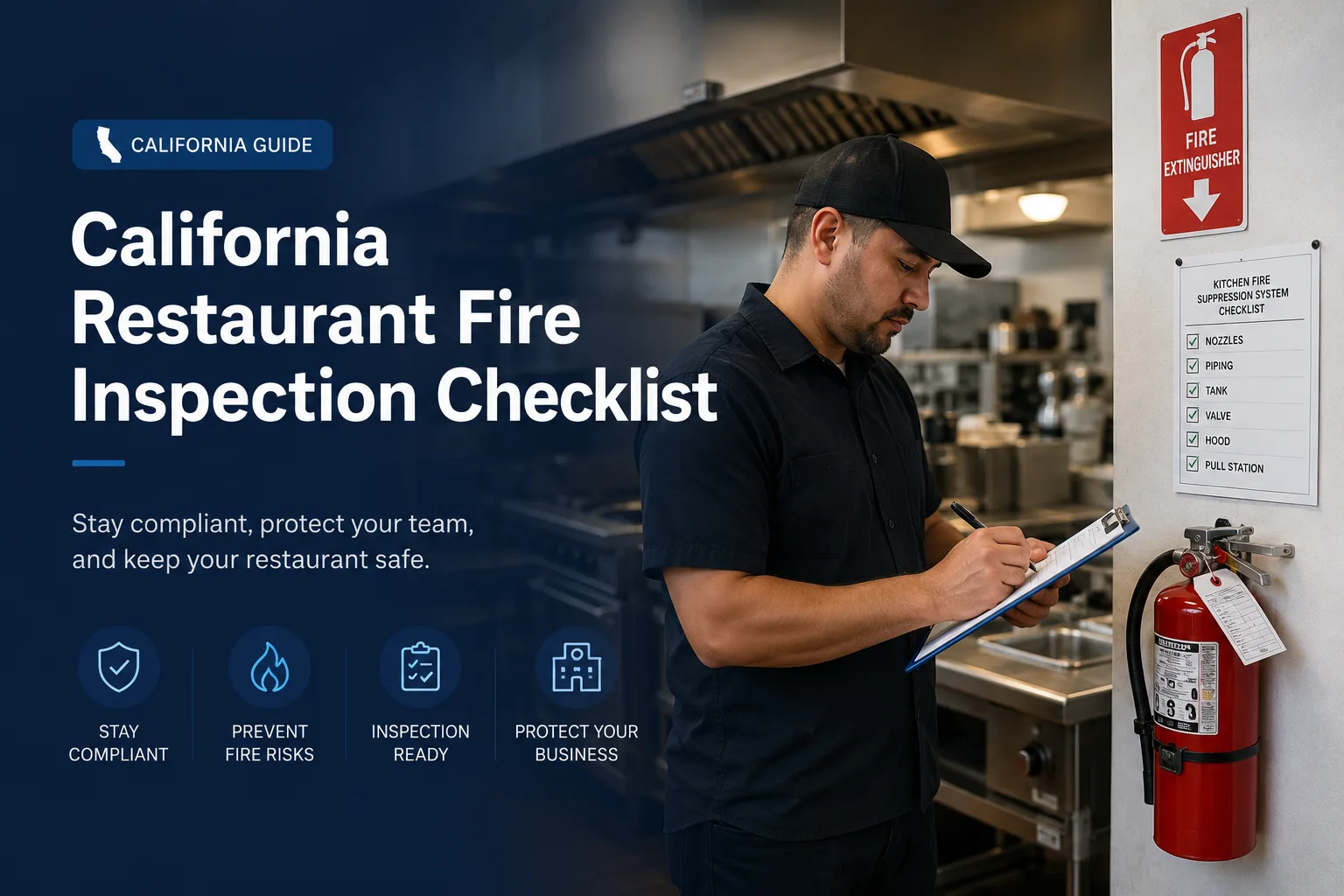
California enforces commercial kitchen fire safety through a stack of standards that most operators only meet one at a time, usually right before or right after an inspection flags one. Pulled together, they answer a question inspectors decide in minutes: is this kitchen's fire protection current, documented, and to code.
Here's what a California restaurant fire inspection actually covers for the cooking line, and the paperwork that proves each item.
What's on a California restaurant fire inspection (Title 19) checklist?
For the commercial cooking line, a California fire inspection centers on two regulated systems and their documentation: the kitchen exhaust hood (cleaned to NFPA 96, enforced statewide through Title 19 of the California Code of Regulations) and the fire suppression system (serviced to NFPA 17A). California Fire Code Section 904.12.5 requires both. An inspector checks that each was serviced on schedule, by a licensed contractor, with a current tag or certificate posted on site.
The two items below are where commercial-cooking inspections are won or lost. Both come down to the same thing: the service was done on time, and you can prove it.
1. Kitchen exhaust hood cleaning (NFPA 96, Title 19 CCR)
California has adopted NFPA 96 as the governing standard for commercial kitchen exhaust systems, enforced statewide through Title 19 of the California Code of Regulations. The required cleaning frequency scales with cooking volume and fuel type, from monthly for solid-fuel and high-volume operations to annually for low-volume kitchens. An inspector looks for a current cleaning certificate, and for evidence that the entire exhaust system was cleaned, not just the visible hood. For the full frequency breakdown, see how often a restaurant hood needs cleaning.
2. Fire suppression system service (NFPA 17A, UL-300)
NFPA 17A requires the wet-chemical suppression system over the cooking line to be inspected and serviced every six months by a contractor holding a State Fire Marshal C-16 license. The system itself must be UL-300 listed; the 2025 update to NFPA 96 eliminated grandfathering provisions for older non-compliant systems. As with the hood, the inspector verifies a current service tag is posted. This is the one requirement with no flexibility on frequency: every commercial kitchen in California is on the same six-month clock.
Who runs the inspection?
The authority having jurisdiction is your local fire department, not a single statewide office. In most of the county that's LA County Fire or, inside the City of Los Angeles, LAFD. Independent cities run their own: Pasadena's commercial kitchen fire inspections go through the Pasadena Fire Prevention Bureau, which enforces the same NFPA standards on its own calendar. The standards are statewide; the inspector and the schedule are local.
What this means for an operator
Passing the cooking-line portion of a California fire inspection isn't about a last-minute scramble. It's about two services running on their required cadence, by licensed contractors, with the tags to prove it. The kitchens that clear inspections without drama treat hood cleaning and suppression service as scheduled obligations, not reactions to a citation.
Boh coordinates both for Southern California restaurants, hood cleaning to NFPA 96 and fire suppression maintenance to NFPA 17A, with the compliance documentation filed after each visit. Book a free kitchen assessment to see where your records stand before the next inspection.
Frequently asked questions
What's on a California restaurant fire inspection (Title 19) checklist?
For the commercial cooking line, a California fire inspection centers on two regulated systems: the kitchen exhaust hood, cleaned to NFPA 96 and enforced statewide through Title 19 of the California Code of Regulations, and the fire suppression system, serviced to NFPA 17A. California Fire Code Section 904.12.5 requires both. The inspector verifies each was serviced on schedule by a licensed contractor, with a current tag posted on site.
How often does a restaurant fire suppression system need to be inspected in California?
Every six months. NFPA 17A requires semi-annual inspection and service of the wet-chemical suppression system by a contractor holding a State Fire Marshal C-16 license, and the system must be UL-300 listed. This is the one commercial-kitchen requirement with no flexibility on frequency.
What is Title 19 for California restaurants?
Title 19 of the California Code of Regulations is the vehicle by which California enforces NFPA 96, the national standard for commercial kitchen exhaust ventilation and fire protection, statewide. In practice it governs how often a restaurant exhaust hood must be cleaned and how that cleaning must be documented.
Who inspects restaurant fire safety in California?
Your local fire department is the authority having jurisdiction. In most of the county that is LA County Fire, or LAFD inside the City of Los Angeles; independent cities such as Pasadena run their own fire prevention bureau. The NFPA standards are statewide, but the inspector and the inspection calendar are set locally.
Ready when you are
Running into issues with your kitchen
Our team coordinates vetted technicians across Southern California, same day for emergencies.