
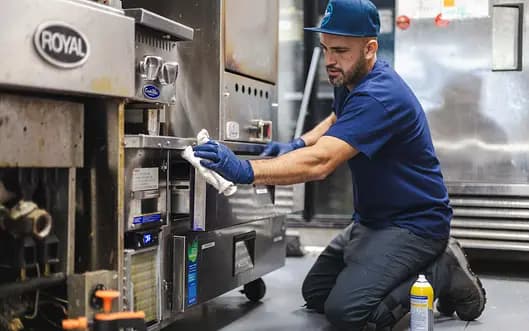
Ice is the only food in your kitchen you make in a machine, store in the dark, and almost never inspect. So when an ice machine starts to degrade, it does it quietly. Output drops a little, a gasket stiffens, a filter clogs, scale creeps across the internal components. Cleaning handles what you can see. Preventative maintenance handles what you cannot, and that is the difference between a machine that runs reliably for years and one that quits mid-service on the busiest weekend of the summer. Boh, which manages back-of-house repairs, maintenance, and compliance for Southern California restaurants, coordinates commercial ice machine maintenance on a documented schedule through vetted specialists. One of the BohPros we rely on for it is CLEAN ICE Restaurant Equipment Maintenance.
What your ice isn't telling you
A clean-looking cube hides a lot. Behind it sits scale narrowing the water lines and coating the evaporator, a water filter past its service life, door or bin gaskets losing their seal, and condenser and fan surfaces collecting grease and dust that force the machine to work harder and run hotter. None of it shows up in the ice until production slows, cubes turn cloudy or soft, or the unit simply stops. By then you are paying for an emergency repair and lost ice during service, not a scheduled visit.
The early signals worth catching: slower or smaller yields, cloudy or off-tasting ice, a unit that runs longer or louder than it used to, water pooling around the base, or visible slime in the bin.
Cleaning is one task. Maintenance is the program
Sanitizing matters. Ice is a food, and health codes treat it that way. But cleaning alone does not replace a spent filter, descale the internal components, inspect gaskets and seals, check refrigerant performance, or confirm the unit is still hitting its production targets. Preventative maintenance bundles all of that into a recurring cadence, so small problems get corrected before they cascade into a breakdown or a failed inspection. Many manufacturers recommend professional service at least twice a year, and quarterly in high-volume kitchens, which is also roughly where filter life and scale buildup tend to land.
Meet the BohPro: CLEAN ICE
CLEAN ICE Restaurant Equipment Maintenance specializes in ice machine maintenance and sanitation for restaurants across Southern California, and according to their site they offer scheduled maintenance programs on a quarterly cadence. They also service walk-in coolers, prep tables, gaskets, AC units, and HVAC, so the same preventative discipline carries across more of the back of house. That calendar-driven, fix-it-before-it-fails approach is exactly why they fit the BohPro network.
How Boh coordinates it
With Boh, the operator does not track the cadence or chase a vendor. Boh is the single point of contact for the back of house. We match the right specialist to the job, a BohPro like CLEAN ICE, schedule the recurring visits so nothing lapses, and return before-and-after photos and service reports that line up with health inspection requirements. Boh does not employ technicians. Vetted BohPros do the work, and Boh coordinates it, documents it, and keeps it on schedule.
That is the larger idea behind Boh: one partner managing repairs, maintenance, and compliance across the entire back of house, so a reliable ice machine becomes one line on a maintenance plan you never have to think about. If your machine is overdue for service, book a free kitchen assessment and we will coordinate the rest.
Frequently asked questions
What does commercial ice machine preventative maintenance include?
A full service typically covers descaling the internal components, replacing or checking the water filter, inspecting door and bin gaskets, cleaning the condenser and fan, sanitizing the water path, and confirming the unit is still meeting its production targets, not just wiping down what is visible.
How often should a commercial ice machine be serviced?
Many manufacturers recommend professional service at least twice a year, and roughly every three months in high-volume kitchens. Water quality, humidity, and usage all shorten that interval, which is why a documented, recurring cadence beats servicing only when a problem appears.
Isn't cleaning the machine enough on its own?
Cleaning handles sanitation, which matters because ice is a food. But it does not address worn filters, gasket failure, scale on the components, or declining output. Preventative maintenance catches those before they turn into a breakdown.
What are the warning signs my ice machine needs attention?
Slower or smaller yields, cloudy or off-tasting ice, longer or louder run times, water pooling, or visible slime in the bin. Any of these means wear or buildup has already set in.
Does Boh employ the technicians who service the machine?
No. Boh coordinates vetted BohPros like CLEAN ICE to perform the work, then handles scheduling, documentation, and follow-up so the restaurant has one point of contact and a complete service trail.
Ready when you are
Running into issues with your kitchen
Our team coordinates vetted technicians across Southern California, same day for emergencies.