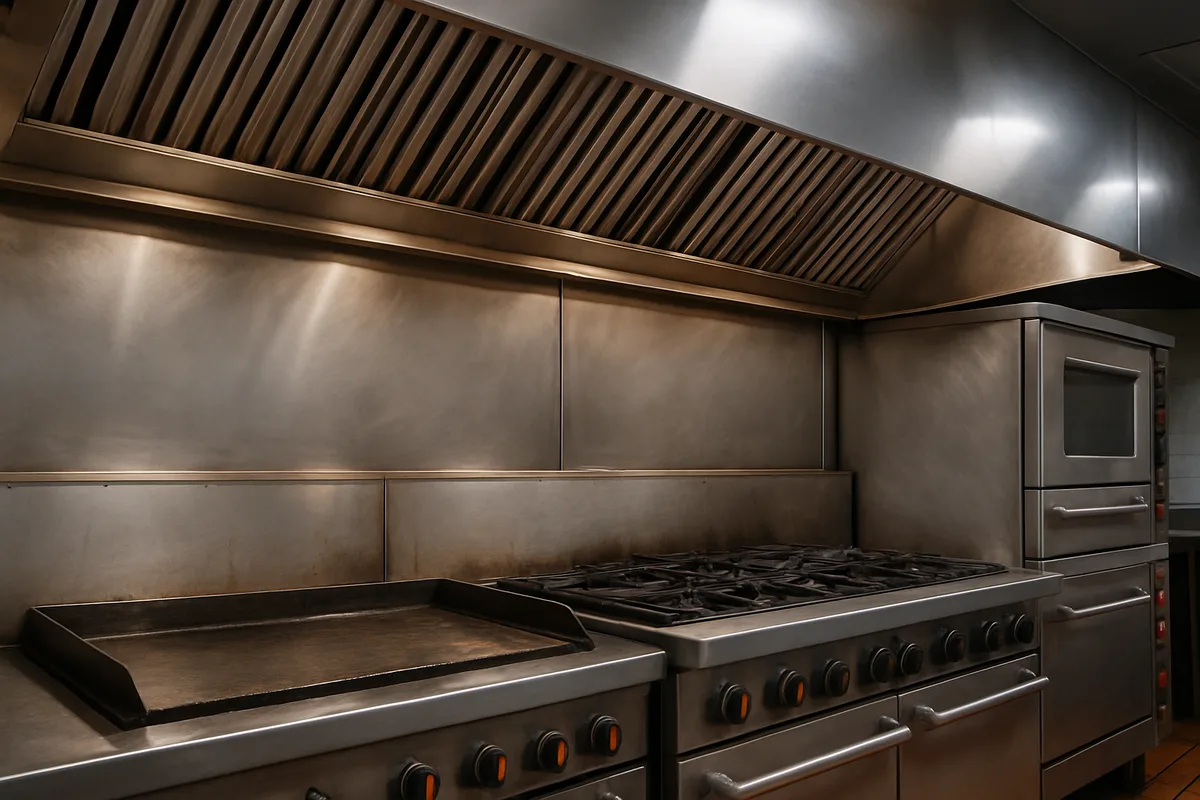
A restaurant hood system does two things simultaneously: it removes grease-laden vapors from your kitchen, and it accumulates the grease that would otherwise build up on every surface in the room. That accumulated grease is the fire risk. The system that protects your kitchen is also the system that, if neglected, becomes the most likely source of a kitchen fire.
In California, hood cleaning is a compliance requirement enforced by two separate authorities — the health department and the fire authority — on independent schedules. Understanding how they interact is the starting point for any maintenance program that actually keeps you compliant.
The regulatory framework in California
California has adopted NFPA 96 (Standard for Ventilation Control and Fire Protection of Commercial Cooking Operations) as the governing standard for commercial kitchen exhaust systems, enforced statewide through Title 19 of the California Code of Regulations (CCR) by the State Fire Marshal (CAL FIRE).
At the local level, the Authority Having Jurisdiction (AHJ) — in most of LA County, that's the Los Angeles Fire Department (LAFD) or LA County Fire — can impose requirements that go beyond the state baseline. The LAFD conducts its own inspection program for commercial kitchen exhaust systems, separate from LA County Environmental Health inspections.
This means a restaurant in LA County is subject to two independent compliance tracks:
- Health inspection — LA County Environmental Health, under CalCode. Hood ventilation citations appear on your health inspection score. An exhaust hood with visible grease accumulation or inadequate airflow is a citable violation averaging 1.0 point per citation in the dataset of 31,856 LA County inspections.
- Fire compliance — LAFD or LA County Fire, under NFPA 96 / Title 19 CCR. This tracks cleaning documentation, certification tags, and system integrity — independent of the health inspection.
Passing a health inspection with no hood citation does not mean your fire compliance documentation is current. Both need to be maintained independently.
Hood cleaning contractors in California must hold a C-61/D-28 specialty license from the California Contractors State License Board (CSLB). Using an unlicensed contractor doesn't just create a compliance gap — it invalidates the documentation the LAFD expects to see during an inspection. Boh's LA crews are licensed and file LAFD-ready documentation after every hood cleaning in Los Angeles.
Cleaning frequency under NFPA 96 / Title 19 CCR
NFPA 96 Table 11.4 establishes cleaning frequency based on cooking type and volume. The 2025 revision tightened several categories — if your kitchen was previously operating on a quarterly schedule, verify whether your operation type now falls under the monthly requirement.
- Monthly — solid fuel cooking operations (wood, charcoal); high-volume operations running more than 16 hours per day
- Quarterly — high-volume cooking with charbroiling, wok cooking, or heavy fryer use; 24-hour operations
- Semi-annually — moderate-volume sit-down restaurants with standard cooking equipment
- Annually — low-volume operations: seasonal facilities, churches, senior centers
Most full-service restaurants in LA County fall into the quarterly category. A restaurant operating a high-volume broiler line or running a wok station is in the monthly category regardless of overall volume. If you're unsure which category applies, the default conservative position is quarterly — scheduling more frequently than required has no compliance downside.
NFPA 96 Section 11.6.1 also establishes a condition-based trigger that operates independently of the schedule: if an inspection reveals grease deposits anywhere in the system, the entire exhaust system must be cleaned before the next service period. The schedule sets the maximum interval — visible grease shortens it.
What a compliant cleaning service covers
A compliant hood cleaning visit covers the entire exhaust system — not just the hood itself. NFPA 96 requires cleaning of all components where grease accumulates:
- Hood interior — plenum, baffles, and all interior surfaces
- Grease filters — removed, cleaned, and reinstalled or exchanged
- Ductwork — full length from hood to exhaust termination point, including horizontal runs where grease pools
- Exhaust fan — blades, housing, and grease containment cup at the rooftop unit
- Access panels — NFPA 96 2025 requires additional access panels in ductwork for inspection and cleaning; systems without adequate access must be retrofitted
After cleaning, the contractor posts a certification tag on the hood showing the date of service, the company name, and the areas cleaned. This tag is what the LAFD inspector looks for first. An expired or missing tag is a citable violation regardless of the actual condition of the system.
The contractor must also provide a written service report documenting what was cleaned, any deficiencies found, and photo documentation. Under the NFPA 96 2025 updates, digital documentation is now required — paper-only records no longer meet the standard.
Between professional cleanings
Professional cleaning handles the grease that accumulates in the ductwork and exhaust fan — areas staff cannot access. Between visits, daily and weekly maintenance by kitchen staff keeps the visible components in condition and catches early warning signs.
Daily — wipe down hood exterior surfaces after service. Check that grease collection cups or drip trays are not overflowing. Verify airflow feels adequate — a noticeable reduction in suction during service is an early indicator of filter loading or duct restriction.
Weekly — inspect grease filters for loading. Filters that are visibly saturated should be exchanged, not left until the next scheduled cleaning. A loaded filter restricts airflow, increases the temperature of grease-laden air in the duct, and accelerates grease deposition upstream.
After any cooking equipment change — adding a charbroiler, a wok burner, or a second fryer changes your NFPA 96 classification and may require a more frequent cleaning schedule. Notify your hood cleaning contractor when cooking equipment changes.
Fire suppression system coordination
Hood cleaning and fire suppression maintenance are separate services performed on separate schedules, but they are inspected together by the LAFD. A hood cleaning tag that's current alongside a fire suppression system that hasn't been certified in 18 months creates a compliance gap that will be cited.
Under NFPA 96 2025, all fire suppression systems must be UL-300 compliant. Previously grandfathered pre-UL-300 systems must now be upgraded — there is no longer a grandfather provision. If your system was installed before the UL-300 standard and hasn't been replaced, this is an active compliance issue.
Fire suppression systems require semi-annual inspection and certification by a licensed contractor, regardless of hood cleaning frequency. The two schedules should be coordinated but are not interchangeable — a hood cleaning visit does not satisfy the fire suppression certification requirement.
Documentation requirements
The documentation package the LAFD expects to see during an inspection:
- Current certification tag posted on the hood — date, contractor, areas cleaned
- Service reports from all cleaning visits within the past compliance cycle
- Photo documentation from each service visit (required under NFPA 96 2025)
- Fire suppression system certification — current, within 6 months
- Any deficiency reports from previous inspections and documentation of corrective action
Keep service records on-site and accessible. An inspector who cannot locate documentation during a visit will cite for non-compliance even if the cleaning was performed. The record is the compliance — not the clean hood.
For context on how hood compliance connects to your health inspection score in LA County, the analysis of 31,856 LA County inspections covers the violation categories and point costs in detail. For the filter-specific maintenance schedule that sits between professional cleaning visits, the hood filter cleaning guide covers what staff can manage in-house and when filters need to be exchanged professionally.
Frequently asked questions
How often should I clean my restaurant kitchen hood?
Daily or weekly in-house cleaning of filters and visible surfaces is essential, with monthly deep cleaning by professionals. The frequency depends on your kitchen's volume and cooking type, but consistent cleaning prevents grease buildup that creates fire hazards.
What's the difference between hood cleaning and hood maintenance?
Cleaning removes visible grease and debris, while maintenance includes mechanical inspections, motor lubrication, airflow testing, and safety checks. True hood maintenance requires all three levels—cleaning, preventive maintenance, and technical inspections—not just surface wiping.
Do I need a professional to inspect my kitchen hood?
Yes, licensed HVAC or hood maintenance providers should perform technical inspections to check ductwork, compliance with fire codes (NFPA 96), and fire suppression system integration. These inspections are often required by insurance companies and health departments.
What happens if I don't maintain my restaurant hood properly?
Neglected hoods create serious fire hazards, lead to system breakdowns during service, and result in failed health inspections and costly repairs ($10,000+). Grease buildup in hidden areas like ductwork is a major fire risk even if the visible hood looks clean.
Ready when you are
Running into issues with your kitchen
Our team coordinates vetted technicians across Southern California, same day for emergencies.